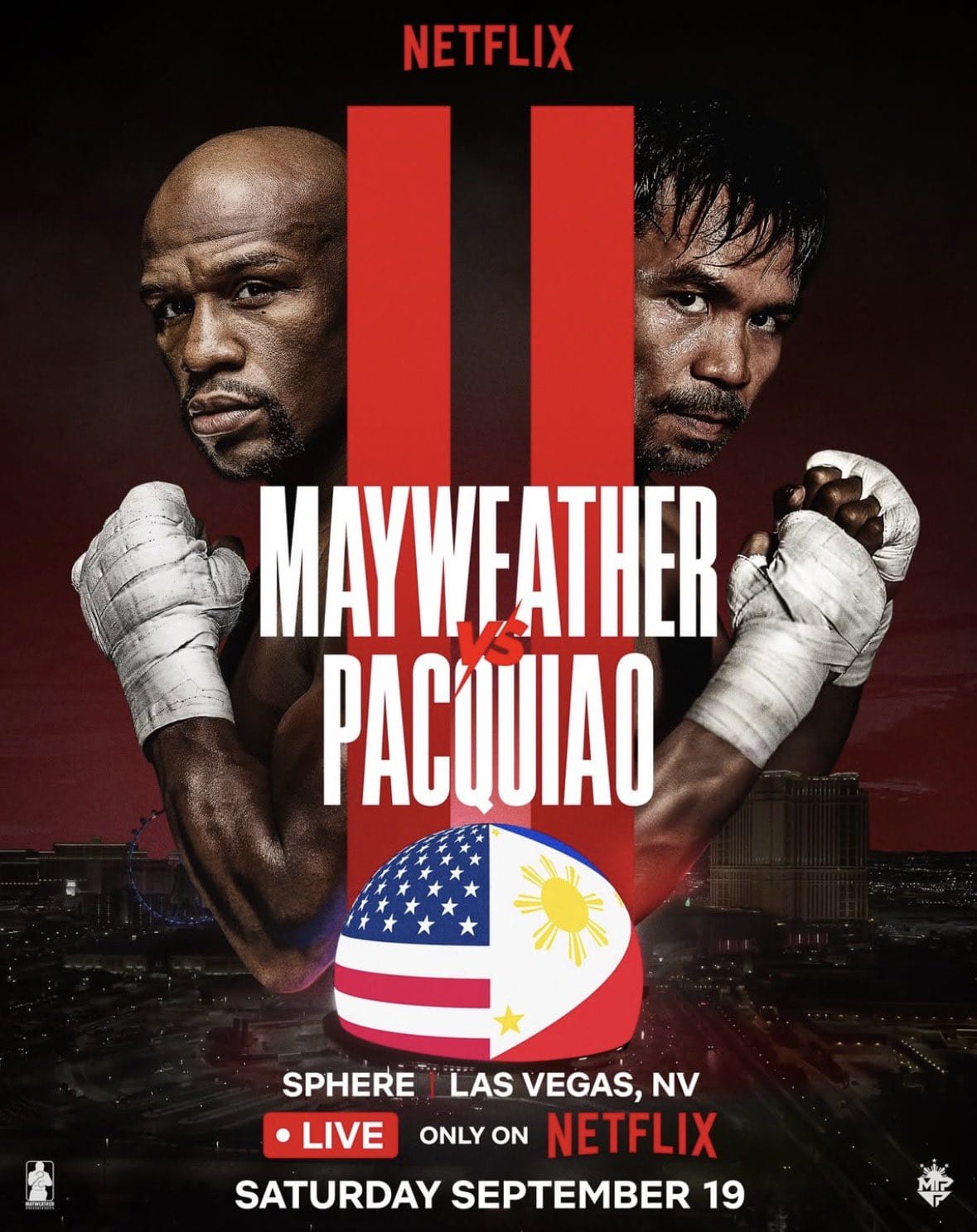
The rematch on September 19, 2026 at the Sphere in Las Vegas (Netflix) is a collision of two philosophies: swarm-pressure (Pacquiao) and counter-punching (Mayweather). Understanding that clash is the key to reading every round.
The first fight gave a clean data point: pressure can win rounds (4 and 6), but only when it’s sustained and effective. The rest of the night belonged to the counter-puncher. Here’s the technical picture — and what has to change for the rematch to tell a different story.
Two Styles, One Ring
Manny Pacquiao fights as a southpaw pressure fighter. He moves forward, throws in volume, mixes head and body, and uses hand and foot speed to create angles. At his peak he was throwing 100+ punches per round and breaking opponents with relentless combos.
Freddie Roach turned him into a two-handed, multi-punch machine — hooks, straights, uppercuts, off-angles. Roach’s pre-fight breakdown (SI) spelled out the strategy: move right to stay off Floyd’s piston-rod right hand, cut the ring, and “take one to give one.” The killer instinct had to show up.
Roach also gave a full category-by-category read (Bad Left Hook): punching power to Pacquiao, footwork (angles, in-and-out, side-to-side) to Pacquiao, ring IQ and experience to Mayweather. The plan: be more aggressive, don’t let Floyd rest, attack when he’s on the ropes. In 2015 we didn’t see that version. Manny fought tentatively, toe-to-toe in the center at the distance of Mayweather’s jab instead of pressing to the corners (Bleacher Report).
Robert Garcia (Maidana’s trainer) had said before the fight: “Stay on him, don’t give him any time to breathe, that’s the only way.” We got the opposite: Manny gave Floyd time, and the volume never materialized.
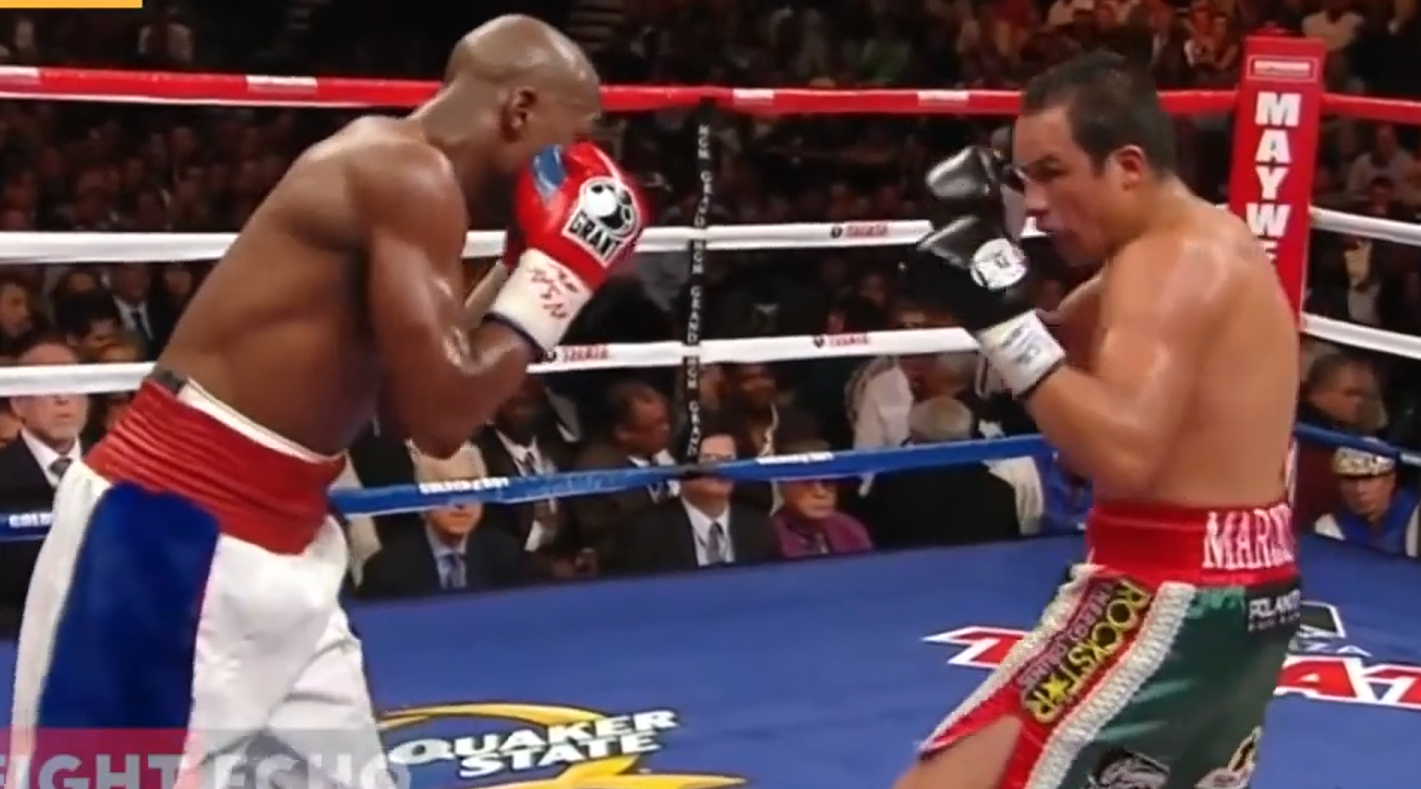
Floyd Mayweather is the counter-puncher. He controls range, uses the Philly Shell and shoulder roll to deflect and evade, and punishes every committed punch. He doesn’t need to throw more; he needs to land cleaner and take less.
Opponents land around 16% on him (CompuBox); he lands 46%. That +30% hit-and-don’t-get-hit gap is the fight. Film-study breakdowns (Bloody Elbow) describe his game as winning exchange after exchange: every time Manny stepped in, Floyd slipped, blocked, or tied up, and when Manny was off balance Floyd landed the lead right or jab.
Steve Bunce on BBC Radio 5 live put it bluntly after the first fight: “Manny lost the fight, and he lost his way. He seemed to run out of ideas.” Anthony Crolla, also on BBC: “Once they get in there and realise how hard it is to hit Floyd Mayweather, it just breaks their heart.”
What Happens When They Meet
Pressure tries to force the counter-puncher to fight in bursts, on the ropes, and at a pace they don’t want. The counter-puncher tries to keep the fight at distance, score with single shots and short combinations, and make the pressure fighter miss and pay.
Mayweather’s defence and counters are built to neutralize aggressive, forward-moving styles (Bad Left Hook): jabbing on the way out, controlling distance, making Pacquiao miss and countering. In 2015 the counter-puncher solved it.
First fight, by the tape: In rounds 4 and 6 Pacquiao had Floyd on the ropes and let his hands go. In R4 a combination ended with a hook that landed with authority and backed Mayweather to the ropes; Pacquiao opened up and Mayweather went to a high guard and blocked most of it — but it was Pacquiao’s first clear round.
In R6 Pacquiao landed a four-punch sequence; most of it landed on Floyd’s arms and he couldn’t break the high guard, but the crowd and the aggression gave Manny the round on many cards. So pressure did create windows.
The problem: the rest of the fight, every time Manny took that final half-step to unload, Mayweather anticipated, moved, and twisted him (BoxingScene rewatch). Manny’s feet were too static; he didn’t cut angles. Roach complained about Mayweather “running”; analysts countered that Floyd fought a defensive fight, used the ring, and escaped the ropes when Pacquiao pushed — he didn’t run, he reset.
Round 8 flipped the script: Floyd’s hard right stunned Pacquiao, then a left hook. After that, Manny never had the same belief or output. Round 4 showed Manny could hurt Floyd when he applied pressure correctly; Round 8 showed Floyd could hurt Manny and that one counter could change the psychology. In the rematch Manny needs more Round 4s and no Round 8s.
Why it felt “boring”: Floyd’s MO is to make the fight boring for the other guy. He took no risks, held when he had to, moved when he had to, countered when Manny committed. Technical masterclass for purists, snooze for casuals.
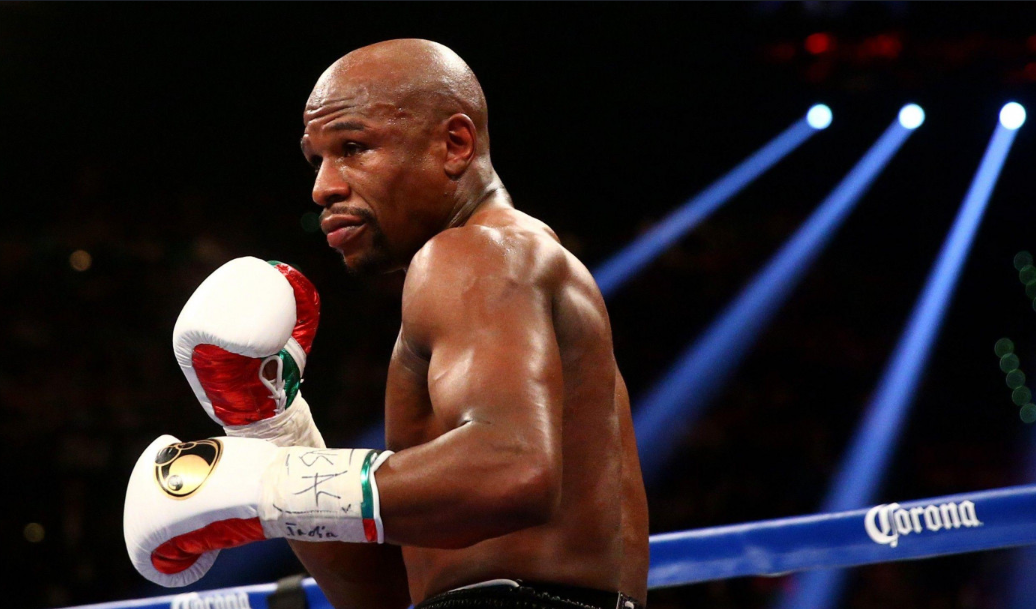
Oscar De La Hoya: “I like the fans getting their money’s worth by watching an action-packed fight. I’m just not into the boxing, running style.” Lennox Lewis: “Doesn’t take away from fact that Floyd is a great technician.” Both can be true — and for the rematch, the question is whether a healthier Manny can force a different kind of fight.
The Maidana Benchmark: Pressure Can Land on Floyd
The “pressure vs counter” template isn’t doomed against Mayweather — it just has to be executed with enough volume and accuracy.
Maidana had size and a mauling style; Floyd chose to stand in fight one and was on the ropes for the first four rounds. In the rematch Floyd moved constantly and won a fairly lopsided decision. So the lesson is double: pressure can land on Floyd when it’s relentless and accurate, but Floyd can also adjust (move, tie up, spin) so he never gets stuck the same way twice.
Against Manny in 2015, Floyd never let himself get stuck. Pacquiao threw 429 and landed 81 (19%) — nowhere near Maidana’s volume or connect rate. Manny didn’t have Maidana’s size or mauling style, and his right hand was compromised.
So the rematch question isn’t “can pressure ever work?” It’s whether a healthier Manny can get his volume and connect rate into that Maidana-tier range — and whether Floyd, at this stage of his career, can still reset and move when he needs to.
What to Watch in the Rematch
Same stylistic puzzle, different date. Who controls range and pace wins.
Watch for:
- Whether Manny moves right and cuts the ring instead of following in a line
- Whether his right hand is in the fight (jab, hook, body)
- Whether we see multiple "Round 4" moments — ropes, combination, left, body
- Whether Floyd still lands the one counter that changes the round (lead right, pull counter, check hook)
If Manny can't impose his style for long enough, the result will look like 2015. If he can, we get a different fight — and possibly a different scorecard.
Train Like Floyd or Manny for the Rematch
PunchCamp's fight-style camps let you shadowbox like Mayweather (counter-punching, Philly Shell) or like Pacquiao (pressure, volume, combos). No equipment. Guided rounds. Get ready for September.
Download free on Android →For a full breakdown of Floyd's style — Philly Shell, shoulder roll, pull counter — see How to Box Like Floyd Mayweather: The 50-0 Blueprint.
![FightCamp Alternatives 2026 - Home Boxing Apps [Android]](../assets/fightcamp-alternatives/social-share.png)